Posts

Showing posts with the label board of directors

Is It a 'Working' Board?

Image
There's a good chance that if the nonprofit you're part of is small in terms of employees, budget, and programming it was set up to have what's known as a 'working' board. And if you don't have any previous experience with small community nonprofit organizations, your only impression of what board membership means may have come from the silver screen. While you may have visions of being chauffeured to prestigious meetings where you state your opinions and cast votes on various matters of import the reality of board service looks very different and somewhat less glamorous, although (hopefully) highly more satisfying on a personal level. If your organization isn't staffed sufficiently to carry out its mission-related programs, AND raise funds, AND take care of all administrative requirements then it's up to the Board of Directors to roll up their sleeves and perform the work of the organization alongside the staff. It's imperative that board members un...

Sitting vs. Serving: 10 Ways to Be a Better Board Member

Image
  No matter what type of nonprofit you’re with, what their mission is, or whether it has a governing or a working board, there are standards and expectations that come with the job of being a board member. Nonprofits are constantly on the lookout for amazing community members who might climb the not-so-corporate ladder and rise from being a general volunteer to serving on the Board of Directors. Unfortunately, sometimes people rise up only to “sit” on the Board of Directors. If you suspect you’re a “sitter”, I urge you to stand up and engage in a level of service that your nonprofit craves. Here’s a checklist of 10 ways to ensure you’re serving your organization: ü   Attend ALL board meetings. Sometimes life gets in the way, I get that, but most likely when you agreed to become a board member someone told you when board meetings would be; add them to your calendar in advance and please don’t make excuses regarding scheduling conflicts. ü   Feel the mission. Hopefull...

Because Sharing is Caring

Image
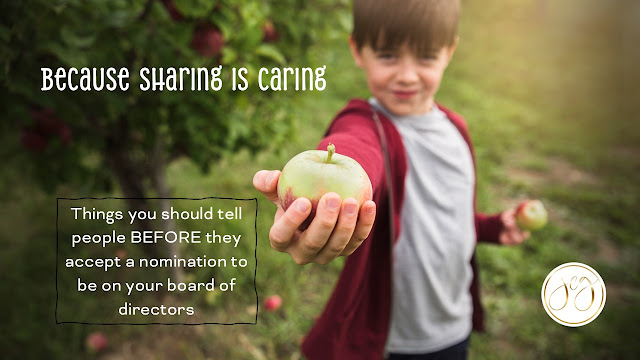
Being on a nonprofit board of directors is a serious commitment. Many community members, even if they’ve been a volunteer for your organization for year, aren’t aware of what will be expected of them when they join your board. I hear many nonprofit staff lamenting over the lack of engagement from some (or even all) of their board members. Lack of engagement can stem from any number of reasons, but one of the most common I have found is simply that people weren’t told what would be expected of them until after they started their first term, and then they either find they can’t uphold all of the expectations and would have turned down the opportunity to serve if they’d had more information ahead of time or they resent no having been told and now they have a bad taste in their mouths. I’ve come to realize there’s a fear among organizations that if they reveal everything they expect of a board member, people will turn them down. If this applies to you, I say let them! If you tell prospec...

RECRUITING NEW BOARD MEMBERS SHOULD BE A COURTSHIP

Image
  I hear from several of my nonprofit clients that board engagement is a challenge; getting board members to do more than just show up once a month for board meetings has proven more difficult than they expected. I like to work from the assumption that community members who agree to join a nonprofit board do so with the best of intentions of giving back, making a difference in their local community. And I do believe that’s true. What I’ve also come to believe, however, is that the average community member doesn’t really understand what being a board member for a small nonprofit organization entails. So, how do we get our board to be more engaged? The bigger question for me is: how can you get board members who are already engaged? People who understand your nonprofit, your mission, the expectations you place on board members and what ‘engagement’ looks like to your particular organization? I’ve talked in several of my presentations and seminars/webinars about what I call the ...

I Witnessed 'The Dream'

Image
I recently attended an event hosted by our local fine arts museum; it was a roving lecture on Pablo Picasso. We walked from room to room, hearing about his art (inspiring, innovative, and thought-provoking) and his personality (philandering, explosive, and troubled) as narrated by a curator. While not on the tour, guests were treated to mulled wine, charcuterie and holiday cheer in a large, open, rentable event space. As some friends and I sat at a table chatting, a man approached us – he was clearly excited about the event – and asked if we were having a good time and had we been on the tour yet. Immediately, I knew what role this man had in the organization. I asked questions about the event space, which had one brick side and looked like it may have once been the original entrance to the museum. He very happily told us all about the renovations that had been done to the museum years ago and their plans for further renovations as well as the expansion onto an adjacent property whic...

Creating Opportunities

Image
I often hear from nonprofit board members that they got involved in an organization to make a difference, but that once they joined, they feel useless – no one calls on them to truly be involved. If you read the Board Engagement ~ Conversation Checklist blog post then you know that one of my suggestions was to sit down and have a chat with each of your board members. Whether you’re the organization’s Executive Director or the Board President, it would be good for you to know what motivates each individual who’s engaged in your board. Even better if you can determine their passions and hobbies. And employ them. This post is meant to help you take those one-on-ones one step further. For many people, volunteering is high on their priority list. However, not everyone wants to give their time to a nonprofit doing the same things they do in their job/career/profession. So, while you might be thrilled to have a lawyer, accountant, marketing person, etc. on your board if directors, th...

10 Phrases Every ED Can Use

Image
You’re a nonprofit leader. People are in awe of what you can accomplish; how much you can get done in a day. But are you a manager? Do you ever feel like you’re so mired down in the day-to-day minutiae that you just don’t have time to see the big picture? No time to implement new processes or ideas? Being an Executive Director is a BIG job especially when you’re leading a little organization, one with little to no staff, save for you. And that’s when it’s especially important to operate like a manager; like the CEO that you are. In my experience as a former (“recovering”) Executive Director, our board met once a month and it somehow always turned into an idea mill. By the end of those meetings, board members had scads of new, fabulous ideas. For ME to plan and implement. My to-do list got longer every time they met. Not to mention all the suggestions and ideas I fielded from donors and well-meaning community members. So what’s an ED to do with a to-do list a mile long (and growing) and...

Annual Reporting

Image
If you’re struggling to find support for your nonprofit organization, you may want to begin tracking certain data to help you build a more compelling narrative. The more you understand what your organization has accomplished, in specific quantitative measures, the more your stakeholders and prospective supporters will be able to grasp the magnitude of the importance your nonprofit has in the community. Nonprofits that aren’t able to show their value, in both quantitative (numbers) and qualitative (narrative) ways often find support lacking in the following ways: Board member disengagement and/or dysfunction Not enough volunteers signing up Volunteers who step forward but don’t commit or follow through Donations waning in number and/or amount Grant applications rejected Partnerships dissolved or waning in commitment The more data you can collect during your fiscal year, the easier you’ll find it to tell your organization’s story. The method of data collection isn’t important – it can be...

Board Engagement ~ Conversation Checklist

Image
Many nonprofit leaders feel as if their board isn’t engaged  *, or not as engaged as they’d like. On the flip side, many board members feel useless, like they want to do more, they just don’t know what to do and no one’s asking them. So, how can we get our directors to go from sitting on a board, to serving the board? It’s really quite simple. Talk to them! I invite you – either the head staff member or the board chair – to meet with board members one-on-one and find out how each member would like to be involved and at what level. The results may surprise you. Some board members will jump at the chance and some may not, but I believe they will all feel good about having had the conversation and the opportunity to be heard. Here's a list of questions or conversation starters you might want to use in these conversations: What first attracted you to our organization? What’s the biggest challenge you feel our organization is facing? And what suggestions do you have for resolving it? Wh...

Board Retreat Cheat Sheet

Image
Board retreats are a fantastic way to create meaningful engagement between staff and board, board member to board member and to solidify the commitment your board has to your nonprofit organization. Unfortunately, sometimes after a retreat, board members go back to status quo and that’s not ideal. Typically, a board retreat is put together with the hopes that board members will be re-energized, re-connected and renewed in their zeal to help lift an organization to a higher level of success. Here's a list of things I’ve found to be helpful in creating a retreat that will have a positive, lasting impact on your organization and the people you count on for its success: Decide what challenges you want to work through at the retreat and what outcomes/goals/deliverables you’ll be working toward. Make it a full-day or 2-day retreat. Eight solid hours if it’s only one day, six hours each day for 2-days. The best times of year for 2-day retreats to get the highest level of attendance (appr...